Korea's Golf Course Market: Four Lenses for Institutional Investors
To an outside investor, Korea's golf course market can look like a single, undifferentiated asset class.
In practice, courses vary meaningfully along four dimensions — business model, location, physical scale, and ownership structure — each of which shapes how an asset is financed, operated, and eventually transacted.
This overview summarizes the current market along those four lines.

Contents
1 Membership vs. Daily-Fee (Public) Courses — Business Model and Market Mix
2 Regional Distribution — Where the Assets Are Concentrated
3 Course Scale — Classifying Assets by Hole Count
4 Ownership & Operating Structure — Chaebol Portfolios, PE-Backed Platforms, and Owner-Operator Separation
★ Summary — Key Takeaways by Category
01 Membership vs. Daily-Fee (Public) Courses
The most fundamental distinction in the Korean market is between membership courses and daily-fee (public) courses.
Membership courses require members to pay a large upfront fee
— historically structured in Korea as a refundable membership deposit rather than an outright purchase, a financing feature with no direct Western equivalent that has, in effect, functioned as a form of member-funded capital for the operator.
Daily-fee courses, by contrast, charge a straightforward green fee with no membership requirement, and are open to any paying golfer.
Of the 546 golf courses nationwide, only 153 operate on a membership basis; the remaining 393 are daily-fee.
Daily-fee operation carries tax advantages under Korean law, and as the golfing population has broadened beyond a traditional membership-driven, high-net-worth customer base, the daily-fee model has become the more scalable business — over the past decade, 82 courses have converted from membership to daily-fee status.
Utilization data bears this out: in 2024, Korean golf courses recorded roughly 47.41 million rounds nationwide, of which 15.31 million were played at membership courses and 32.11 million at daily-fee courses.
With membership prices no longer appreciating the way they once did, the shift toward daily-fee operation is likely to continue — a trend relevant to anyone underwriting the future revenue mix of a Korean golf asset.
02 Regional Distribution
The second lens is geography.
The Seoul metropolitan area (Gyeonggi, Incheon, and Seoul) accounts for the largest concentration, with 173 courses, reflecting the region's population density and golf demand.
The Yeongnam region (Busan, Daegu, and surrounding areas) follows with 118 courses.
Chungcheong and Honam each have 75, Gangwon has 65, and Jeju has 40.
Concentration in the capital region and Yeongnam is a straightforward function of proximity to demand — both are within easy reach of major population centers.
Chungcheong and Honam sit along the corridor connecting the capital region to the south, capturing overflow demand from nearby metro areas in addition to local play.
Gangwon has developed many of its courses as four-season extensions of existing ski resorts.
The capital region also carries a distinctly higher share of membership courses — 70 of its 173 courses are membership-based, well above the national average.
Jeju, despite having fewer courses overall, also carries a high membership share, and is the region most exposed to a structural headwind: Korean golfers increasingly traveling abroad to play, which has begun to erode Jeju's domestic rounds first.
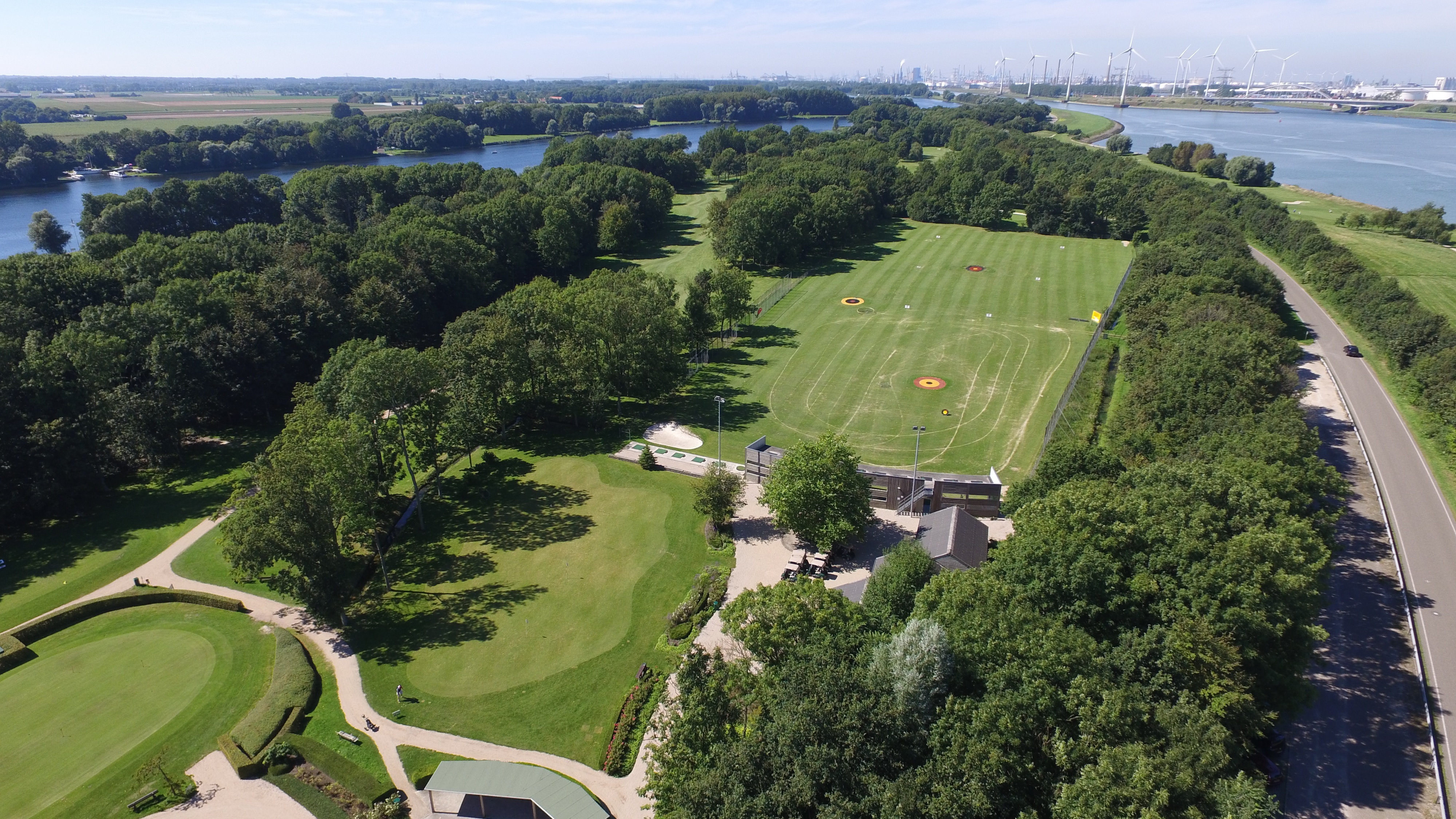
03 Course Scale (Hole Count)
The third lens is physical scale, measured in holes.
Because a standard round is played over 18 holes, most Korean courses are built in multiples of nine — 9, 18, 27, and 36-plus — so that individual nine-hole loops can be combined flexibly into different round configurations.
A nine-hole facility is rarely a stand-alone asset; it is typically one loop within a larger 27- or 36-hole property.
Anything above 27 holes is best understood as a multi-course, resort-scale asset rather than a single golf course.
Samsung's Anyang Country Club, SK's Pinx Golf Club, and LG's Gonjiam Country Club are all single 18-hole courses, whereas Samsung's own Lakeside Country Club runs to 54 holes and Anseong Benest to 36.
As hole count increases, these properties increasingly come bundled with lodging and food-and-beverage facilities — in effect, integrated resorts rather than single-purpose golf assets.
04 Ownership & Operating Structure
The fourth lens is who owns and operates the course.
Among Korea's conglomerates (chaebol), Samsung holds the largest portfolio — six courses totaling 162 holes, including Anyang CC, Lakeside, and Gapyeong Benest — followed by Hanwha (5 courses, 99 holes), GS (4 courses, 99 holes), HD Hyundai (5 courses, 90 holes), Lotte and Hyundai Motor (2 courses each, 54 holes), POSCO (3 courses, 51 holes), and SK and LG (1 course each, 18 holes).
Outside the chaebol-affiliated portfolios, the largest single operator is Golfzon County, a private-equity-backed daily-fee platform, which runs 15 courses totaling 288 holes — a larger hole count than most of the conglomerate portfolios above.
Once these well-known corporate and platform owners are set aside, the majority of Korea's golf courses are held by individuals, small and mid-sized corporations, or local governments and public agencies.
A growing share of new transactions separate ownership from operations entirely: a private equity fund or a special-purpose company (SPC) acquires the course, then contracts a specialized third-party operator to run it.
This owner-operator split — increasingly common in recent deals — is worth flagging for any investor structuring a Korean golf course acquisition, since it directly shapes management-fee structures, operating leverage, and exit optionality.

★ Summary — Key Takeaways by Category
● Business model: Daily-fee courses (393) outnumber membership courses (153) by more than two to one, and the mix continues to shift toward daily-fee.
● Regional distribution: Capital region (173) > Yeongnam (118) > Chungcheong / Honam (75 each) > Gangwon (65) > Jeju (40).
● Scale: 18 holes is the standard unit; 27 holes and above typically signals a multi-course, resort-scale asset.
● Ownership: Samsung leads among chaebol-affiliated portfolios; Golfzon County (PE-backed) leads among non-chaebol operators, and SPC/PE-driven owner-operator separation is a growing deal pattern.
Taken together, these four dimensions — business model, geography, scale, and ownership structure — give any Korean golf course a rough coordinate that an outside investor can use to benchmark it against the rest of the market.
Figures reflect nationwide course counts and utilization as of the most recent available industry data (as of January 2026); chaebol and operator portfolios are subject to change through divestitures and acquisitions.
Investors should confirm current figures against the latest disclosures from individual operators and industry associations before relying on them.
'골프장 개발, 시공, 운영 등' 카테고리의 다른 글
| 골프장 유형, 분포 등 분류기준 어떻게 될까? (0) | 2026.09.10 |
|---|

댓글